
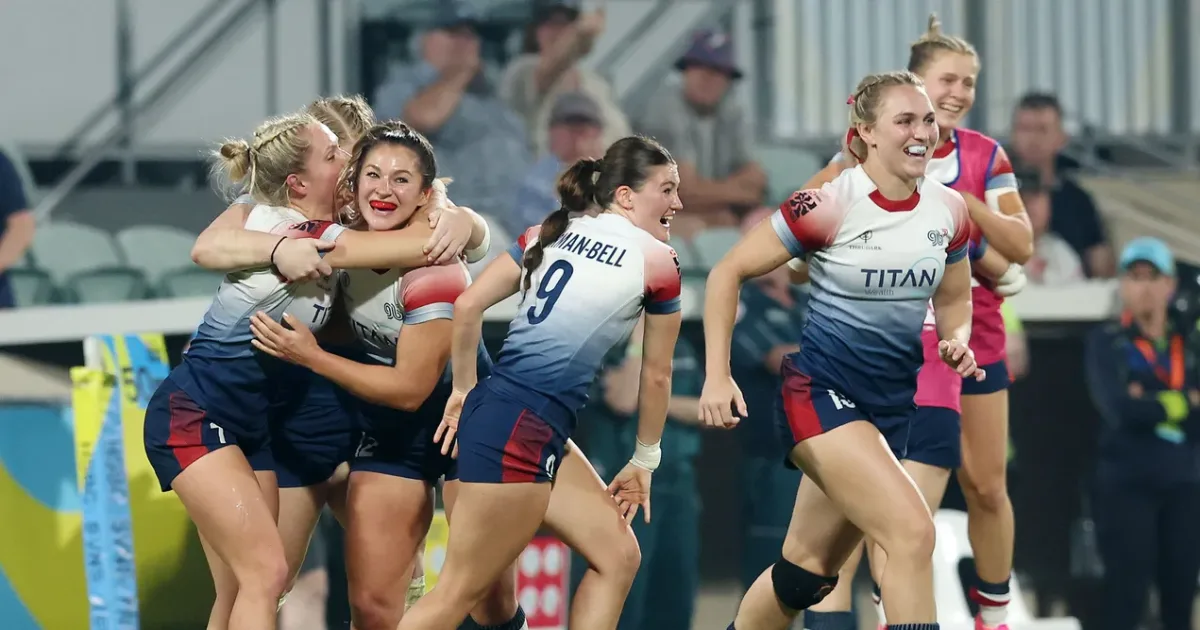
Harry Glover is many things. Co-founder, former Wasps and Stade Français player, England Rugby and Team GB Sevens international, MVP of the World Sevens Tournament. The man has been to the Tokyo Olympics and is in line for LA. So when we started working with Team GB Sevens, it was never going to be purely transactional. A lot of the players were already using CONKA anyway. Joe Lyden was CEO at the time, had been a professional athlete himself, understood the risks around repeated head injury, and was a strong advocate for the product. He felt it was only right that the players were at least offered it as an option. That was the beginning.
What followed taught us something we were not entirely expecting: that cognitive performance and injury risk may be more connected than most sports programmes currently account for.
How the GB Sevens Partnership Started
We were operating with one product at that point. Just Flow. No Clear. The women's trial, in particular, started surfacing something odd. Cognitive scores were fluctuating significantly across the week, and when we mapped that against GPS data and training load, the troughs lined up. High workload weeks were hitting brain performance harder than we had anticipated. That observation is what eventually drove us to develop the antioxidant-based formula for CONKA Clear.
Noticing that the Flow formula might need some heavy lifting when it came to supporting glutathione production and blood flow around the brain, we began to understand that it was the synergistic effect between the two formulas, as much as within each one, that made this combination work. In practice, the squad started top-and-tailing contact sessions: Flow every morning as the daily foundation, a dose of Clear in the five minutes before anything that genuinely mattered, particularly around high-intent training blocks.
The Injury Pattern Nobody Was Tracking
Here is the part that still sits with me. Across the trial, the injuries that occurred tended to happen when cognitive performance scores were at their lowest. That is not a casual observation. It lines up with a body of existing literature on the relationship between cognitive function and injury vulnerability.
Research published by Barlow et al. in 2024 found that female athletes face elevated injury risk during the luteal phase of their menstrual cycle, when progesterone levels rise and cognitive performance can decline measurably. Within our women's trial data, Player 4's case was particularly striking. Two days before her injury, she was in her late luteal phase, had reported fewer than five hours of sleep, was experiencing severe muscle soreness and had recorded her lowest cognitive score of the trial: 76. The injury followed shortly after.
Player 9 showed a different but equally clear pattern. Cognitive performance dipped during her early luteal phase and her period, then climbed steadily through the follicular phase, peaking at ovulation. One player's data is not a conclusion. But across multiple players, the trends were consistent enough to warrant attention from anyone running a women's sport programme.
Beyond the hormonal dimension, intense touring schedules add another compounding layer. Travelling across multiple time zones repeatedly disrupts sleep architecture and circadian regulation, both of which have downstream effects on processing speed, reaction time and decision-making. In a contact sport, slower decisions are not just a performance problem. They are a safety problem.
What the Cognitive Data Actually Showed
The GB Sevens Women's Team improved cognitive performance by 5.08% from baseline to the CONKA testing period, in a single month. Three players posted improvements above 10%. Player 3 was the standout, improving by 15.2% across the trial. Player 6 gained 13.6%. Player 9 gained 10.4%.
The men's team told a different story about absence. During the two months off CONKA, team improvement dropped to 0.85%. In the single month prior on CONKA, it had been 10.12%. Losing most of a season's worth of cognitive gain in the off period is not a trivial finding.
Across all 1000+ cognitive tests conducted through CONKA's work with elite sport, the pattern we keep returning to is this: performance variability is the real enemy. Consistent cognitive output, day after day and tournament after tournament, is what separates athletes who stay healthy from those who do not.
Why the Formula Was Built the Way It Was
CONKA Flow contains Lemon Balm, Turmeric, Black Pepper, Rhodiola Rosea, Bilberry and Ashwagandha, ingredients selected for their combined effect on the morning cognitive baseline. Ashwagandha modulates the HPA axis, the stress-response system that, when dysregulated by heavy training loads, pulls cognitive performance down.[1] Ashwagandha has been studied extensively for its effects on stress and cognitive function -- see the full research summary on Examine.com. Rhodiola Rosea has demonstrated synergistic effects on both physical and cognitive output under high load.[2] Rhodiola Rosea has been studied extensively for its adaptogenic and performance-supporting effects -- see the full research summary on Examine.com.
CONKA Clear, the formula we built partly in response to what the Sevens data was telling us, contains Vitamin C, Alpha-glycerylphosphorylcholine (Alpha GPC), Glutathione, N-Acetyl Cysteine (NAC), Acetyl-L-Carnitine (ALCAR), Ginkgo Biloba and Alpha Lipoic Acid. Alpha GPC in particular has shown significant improvements in attention and processing speed in trials.[3][4] Alpha GPC has been studied extensively for its effects on attention and cognitive performance -- see the full research summary on Examine.com. Glutathione precursors, specifically NAC, address the oxidative burden that high-contact training sessions place on the brain. Ginkgo Biloba has been studied extensively for its effects on cognitive function and cerebral blood flow -- see the full research summary on Examine.com.
The formulation sits under patent GB2620279 and is Informed Sport certified, meaning every batch is independently tested for banned substances. That matters when you are working with Olympic athletes.
Our clinical work with Durham University and Cambridge University over six years, and the 18.1% performance advantage over caffeine we recorded across 914 cognitive tests, is the foundation this was built on. This is not wellness marketing. It is what the data kept telling us.
The Question Worth Asking Across Every Sport
If lower cognitive performance correlates with higher injury incidence, then tracking brain scores alongside GPS, load data and menstrual cycle phase is not a nice-to-have. It is a missing variable in most performance programmes. The best brain supplements in the UK, or anywhere, are the ones that move the needle on that variable consistently, not just once before a big game.
We are not claiming CONKA prevents injury. The data does not say that and neither will we. What it says is that cognitive performance is measurable, it fluctuates predictably under certain conditions, and those fluctuations may carry consequences beyond the scoreboard.
That is worth knowing. Especially if you are the one making the split-second decisions.
For anyone building a performance programme, or simply interested in what a serious brain health supplement actually looks like in practice, the ingredients behind both formulas are fully documented and the science is verifiable.
Frequently Asked Questions
Q: Does cognitive performance affect injury risk in athletes?
A: Research suggests a link between lower cognitive performance and elevated injury risk. When processing speed and attention decline, reaction time slows and decision-making degrades. In contact sport, those fractions of a second matter. Data from CONKA's GB Sevens trials showed injuries tended to occur when cognitive scores were at their lowest.
Q: Why are female athletes more prone to injury during the luteal phase?
A: During the late luteal phase, progesterone levels rise and can negatively affect cognitive function, coordination and fatigue tolerance. Research by Barlow et al. published in 2024 found female athletes face elevated injury risk at this point in their cycle. Monitoring cognitive scores alongside cycle phase data may help identify and manage those vulnerability windows.
Q: What are the best brain supplements in the UK for athletes?
A: The best brain supplements for athletes in the UK are those that are Informed Sport batch-tested for banned substances, backed by clinical trial data, and formulated for consistent daily use rather than acute stimulation. CONKA holds UK patent GB2620279 and has conducted trials with Durham and Cambridge universities across 914 cognitive tests.
Q: How does travel across time zones affect cognitive performance in sport?
A: Travelling across multiple time zones disrupts circadian rhythm and sleep architecture, which directly impairs processing speed, working memory and reaction time. For athletes on intense international touring schedules, this compounds training load and creates windows where cognitive performance drops and injury risk may increase significantly.
Q: What is a nootropic and how do they differ from standard supplements in the UK?
A: Nootropics are compounds that support cognitive function including focus, memory and processing speed. Unlike general supplements, quality nootropics UK products target specific neurological mechanisms rather than broad wellbeing claims. CONKA's formulas are clinically tested, patent-protected and Informed Sport certified, distinguishing them from the majority of brain health products on the market.
References
- Xing et al. "Effects of Acute Ashwagandha Ingestion on Cognitive Function." International Journal of Environmental Research and Public Health. 2022. (source)
- Liu et al. "Synergistic Effect of Rhodiola rosea and Caffeine Supplementation on the Improvement of Muscle Strength and Muscular Endurance: A Pilot Study for Rats, Resistance Exercise-Untrained and -Trained Volunteers." Nutrients. 2023. (source)
- Kerksick. "Acute Alpha-Glycerylphosphorylcholine Supplementation Enhances Cognitive Performance in Healthy Men." Nutrients. 2024. (source)
- Sagaro et al. "Activity of Choline Alphoscerate on Adult-Onset Cognitive Dysfunctions: A Systematic Review and Meta-Analysis." Journal of Alzheimer's Disease. 2023. (source)
More reading

Cognitive Performance: How Athletes Protect Their Brains
Cognitive performance declines under training load, contact sport and competition stress. Here is what the evidence says about protecting your mental edge across a career.
21 Oct 2026

Brain Fog: Causes, Triggers and How to Clear It Fast
Brain fog is not a mystery. Discover the real causes, from sleep debt to nutritional deficiencies, and find evidence-based remedies that actually work.
19 Oct 2026

How CONKA Ended Up Inside Nike Mind at Oxford Circus
CONKA brain shots ended up inside Nike's Oxford Circus store after boxer Moses Itauma started using them in training camp. Here is how it happened.
19 Oct 2026